




Free commission calculator for salon owners

Find out what your commission split is actually costing you

Every point of commission comes out of the same money that pays you. Drop in last month's revenue and see both numbers together, plus the whole budget behind them. For owners who employ stylists on commission.

Targets and real averages, side by side
Sourced where a benchmark exists
Takes about 20 seconds

Your salon last month

Slide or type. The budget updates as you go.

Do you take clients yourself?

Most owners with a few chairs still work behind the chair.

$

Services only, before tax

$

Product you sold off the shelf

Everyone behind the chair. Include yourself if you take clients.

%

The rate your stylists are on. Not your own rate if you take clients.

$

Of your total service revenue, the part you personally generate.

Total monthly revenue: $44,000

Thank you! Your submission has been received!
Oops! Something went wrong while submitting the form.

What you can afford to pay yourself

$4,746/mo

$56,946 a year, before tax

At your 50% commission rate. Your budget target is $6,893: $2,933 as commission behind the chair, plus $3,960 as the owner's wage for running the business.

The rate your revenue carries

44.0%

You're paying 50% where your revenue carries 44.0%. With payroll taxes, that gap costs $2,240 a month, and it's already taken out of the pay above.

Every extra point of commission costs you about $373 a month, including payroll taxes.

How we work this out

Team pay budget

$17,600/mo

Rent budget

$4,400/mo

Everything else

$17,948/mo

Cushion if you paid the budget rate: $92/mo

Your full budget

18 lines, worked out from your numbers

What you take home
$0,000
Your team
$00,000
Your space
$0,000
Product on the shelf and in the back
$0,000
Running the business
$0,000
Left over
$00

See your numbers now

Every line of your budget, what you can pay yourself, and the commission rate your revenue can carry. Free, and it takes 10 seconds.

Unlock my numbers

No spam. Unsubscribe anytime.

Here's the whole budget

What you take home
$3,960
Your team
$23,496
Your space
$6,160
Product on the shelf and in the back
$4,440
Running the business
$5,852
Left over
$92

Your budget lines add up to more than your revenue. Retail is below the roughly 10% of service revenue this model assumes.

What you take home
$3,960
Your pay (owner)
9%
$3,960
Subtotal
$3,960
Your team
$23,496
Stylist pay (commission + hourly)
40%
$17,600
Support staff (front desk, assistants, managers)
5%
$2,200
Payroll taxes
5.4%
$2,376
Benefits (insurance, vacation, bonuses)
3%
$1,320
Subtotal
$23,496
Your space
$6,160
Rent
10%
$4,400
Utilities
3%
$1,320
Maintenance and repairs
1%
$440
Subtotal
$6,160
Product on the shelf and in the back
$4,440
Backbar and professional supplies (color, foils, shampoo)
6%
$2,640
Retail restocking
45% of retail
$1,800
Subtotal
$4,440
Running the business
$5,852
Marketing
4%
$1,760
Education
1%
$440
Phone and internet
1%
$440
Salon software
0.5%
$220
Card processing and bank fees
2.8%
$1,232
Business insurance
1%
$440
Licenses and permits
1%
$440
Professional savings
2%
$880
Subtotal
$5,852

This model doesn't include retail commission. If you pay it, usually 10 to 15% of retail sales, it comes out of your cushion.

The commission rate your numbers can carry

44.0%

The target for stylist pay is 30 to 35% of total revenue. Total payroll across salons runs about 45%. This model uses 40% of budget revenue for stylist pay, which works out to 44.0% of your service dollars, or about $2,933 per stylist a month. If you're above that, you're not unusual, but the difference has to come from somewhere.

Your software line

This budget puts $220/month against salon software. Slick for 6 stylists is $92/month on Essential or $142/month on Advanced.

Both tiers sit inside that line.

Who made this

This calculator comes from Slick

Slick is salon software built for hair stylists and barbers. It runs your bookings, calendar, card payments, text reminders and marketing from one app, so numbers like the ones you just worked out keep themselves up to date.

10,000 salon pros already run their business on it. In the US, Slick is part of DaySmart.

Online booking
Calendar
Payments
Text reminders
Marketing
Reports
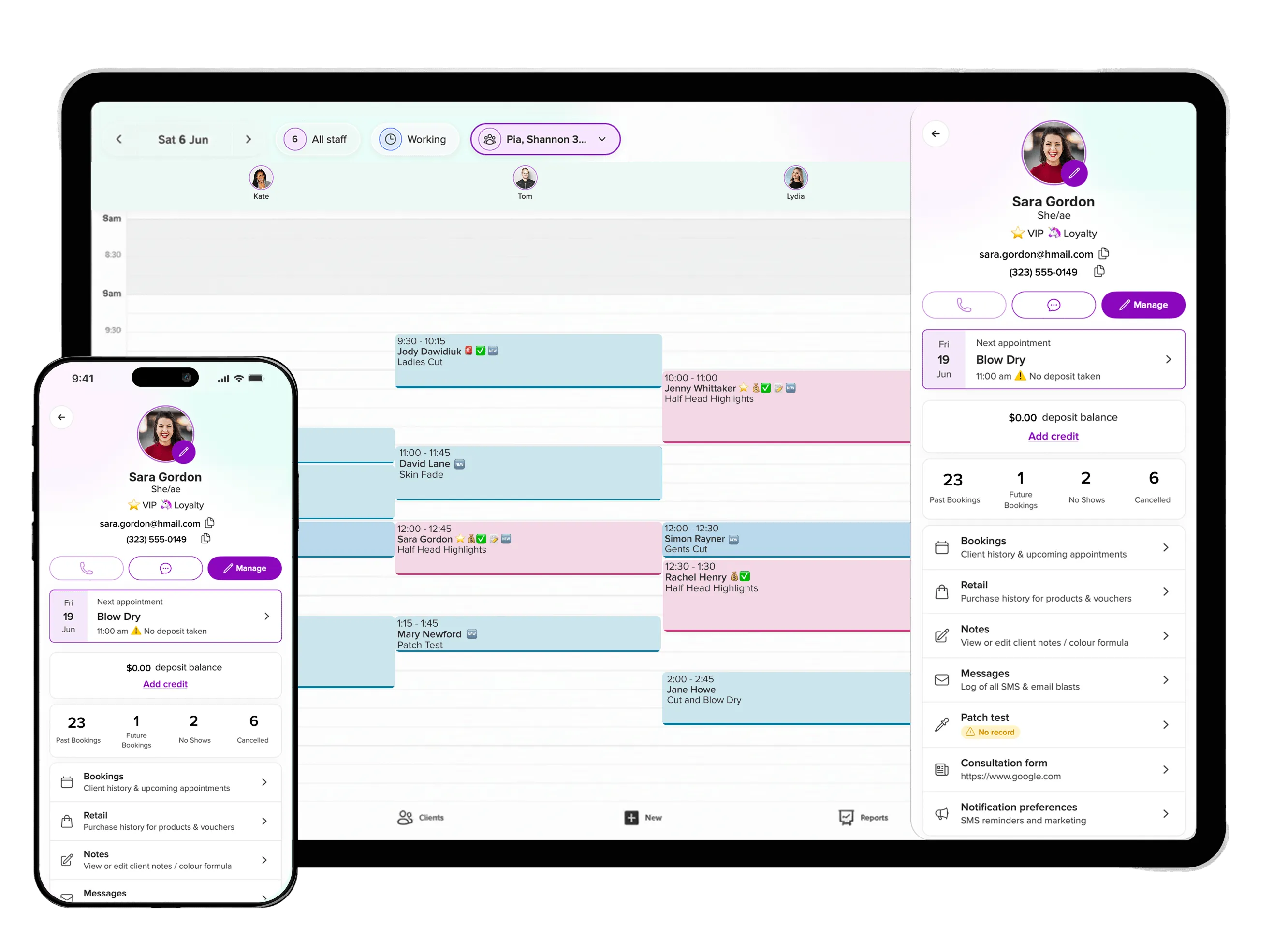
Slick calendar on iPad with a client profile on iPhone
Sarah from Establishment 57 holding a laptop with Slick
SARAH, EX VAGARO
42% more bookings

Sarah switched from Vagaro and grew bookings 42% using Slick's marketing tools.

Read her story →

Trusted by 10,000 salon pros

★★★★★4.9 from salon owners
70%
less no-shows
25%
more bookings
2.1%
POS processing
70%
saving on software

How commission salons usually pay

Before you decide on a raise, it helps to see how other owners structure it. These are common conventions, not rules, and not advice to cut anyone's pay. Your market and your prices move all of it.

A common level system
35 to 40% while building a book, up to 48 to 50% when fully booked.
Level
Monthly service sales
Service commission
Building a book
Under about $3,000
35 to 40%
Established
About $3,000 to $6,000
42 to 45%
Senior, fully booked
Over about $6,000
48 to 50%
  • Stylists move up after holding the next level for three months in a row, not one good month.
  • Retail commission usually sits at 10 to 15%, separate from service commission.
  • 50% tends to be the top of the ladder, kept for stylists who are fully booked with their own clients.

Common coaching convention, not survey data. No published survey of salon commission rates exists that we could stand behind.

Raise the price before you raise the percentage
A higher price pays the stylist more and leaves more for the salon.

When a stylist asks for more, the price usually moves before the percentage does. A higher price pays the stylist more and leaves more for the salon. A higher percentage only moves money from one side to the other.

Starting point

$65 service at 44%

Stylist earns $28.60

Salon keeps $36.40

Raise the rate

$65 service at 48%

Stylist earns $31.20

Salon keeps $33.80

Raise the price 10%

$71.50 service at 44%

Stylist earns $31.46

Salon keeps $40.04

A common trigger for a price rise is being booked 85% or more for two to three months running. Start with around 10% and check the book again after a couple of months.

One catch: if commission is paid on the full ticket, part of every price rise goes straight back out as commission, including the part that covers color. Some salons split color services into product and labor and pay commission on the labor only.

What you owe on top of commission
Minimum wage, overtime, employer taxes and product charge limits.

A commission stylist on your payroll is an employee, so the costs don't stop at the percentage.

Minimum wage, every week

Commission has to cover at least minimum wage for every hour worked in the week, including time waiting between clients. If it falls short, you top it up. Many salons write it as 'commission or hourly, whichever is higher'.

Overtime counts commission

Past 40 hours, overtime is owed, and commission is part of the rate it's calculated on.

Employer taxes

7.65% for Social Security and Medicare, federal unemployment on the first $7,000, plus your state's unemployment rate and workers' comp. This model allows 5.4% of revenue for it.

Product charges have a floor

A backbar or product charge can't take anyone's pay below minimum wage or overtime for the week. Some states restrict deductions further.

General information, not legal advice. Rules vary by state, so check with your payroll provider or an employment attorney.

Where a number has a source, we cite it. See where these numbers come from

Where commission salons lose the margin, and how Slick fills the gaps

Four leaks that pull money out of the lines above, and how Slick plugs each one.

No-shows leave your costs running

Your stylist loses the commission and the salon loses the revenue, while rent and the rest of your costs keep running.

What plugs it

Slick digital appointment cards take a deposit up front, so a gap costs you less.

Card processing skims the top

A point of processing on real salon volume is thousands a year you never see on a statement.

What plugs it

Slick is 2.1% in person.

Retail sits in a drawer, not on the shelf

This budget assumes retail is about 10% of your service revenue. Fall short and the budget comes up short too.

What plugs it

Slick stock tracking keeps restocking matched to what actually sold.

You don't know who's actually profitable

One stylist can carry the team line while another quietly sits under it, and the totals hide both.

What plugs it

Slick per-stylist reporting on service and retail.

Hear it from the pros

Salon owners who made the switch.

Sarah
Sarah
ex Vagaro

Increased bookings by 42% with Slick's marketing

Abbie
Abbie
ex appointment book

Grew her revenue by 20% with Slick

Leah
Leah
ex Fresha

Saved thousands on client fees since leaving Fresha

Jordan
Jordan
ex Salon IQ

Cut costs by thousands since moving to Slick

Moving to the slick was one of the best decisions we've made! The team are fab! Super quick with any help we might need and easy to talk to, thanks for everything!

Atelier Hair

Love Slick. It works beautifully, great for appointment management, text blasting clients, reminder texts are part of the package and the customer service support is outstanding. Brilliant!

Hairography

The most innovative and relevant Salon system I've ever worked with always listening to our requirements always delivering and always coming out with new solutions for our working day

Wilde About Hair

it's been so easy to get used to, we're so pleased to have changed over from previous difficult systems. They're brilliant at helping with your business

Serenity Hair

Pricing Plans

How many bookable staff?
Essential
For freelancers & solo stylists
1 Staff
$22 per month
Cost per staff member:
$22/month
Unlimited SMS reminders
Includes 50 marketing SMS
Value of SMS included: $17.50
Supercharged plan is best for you
Recommended
Advanced
For small to medium businesses
1 Staff
$37 per month
Cost per staff member:
$37/month
Unlimited SMS reminders & Confirmations
Includes 500 marketing SMS
Value of SMS included: $17.50
Supercharged plan is best for you
Supercharged
For large businesses with 10+ staff
1 Staff
$250
 per month
Cost per staff member:
$25/month
Unlimited SMS reminders & Confirmations
Includes 2000 marketing SMS
Value of SMS included: $17.50

Want a second pair of eyes on those numbers?

We'll walk your budget with you and show you where Slick fits. Takes about 20 minutes.

Questions salon owners ask us

What if I don't know my exact commission rate?

Use your best guess and slide it. The point isn't the decimal, it's the gap. If the rate you pay is a few points above what your numbers carry, that difference is coming straight out of your own pay, and a few points is usually thousands a year.

Where do these percentages come from?

Seven of the eighteen lines come from published industry benchmarks, listed with sources under the calculator. Eight have no established benchmark we could stand behind, so we've labeled them as the model's working allowance. The other three show a target or a worked-out allocation. We started from the budget model commission salons commonly use, then corrected four lines that didn't match the published data.

What if I'm also behind the chair?

Switch on 'Do you take clients yourself?' at the top of the calculator and tell it how much service revenue you personally bring in. You get paid twice in a commission salon: a commission on your own clients out of the team pay budget, and a wage for running the business. The calculator adds both together.

My rent is way over 10%, what now?

Rent is the hardest line to move, so something else has to give. Usually it's the team line, retail performance, or price. Look at revenue per square foot first. If rent is 15% of your income, you need the revenue to catch up to the space.

My stylist is asking for 50%. Should I say yes?

It depends on what she brings in, not on the number. 50% is usually the top level, for stylists fully booked with their own clients. Slide the commission rate above to 50% and look at the gap. If it's big, a price rise often gets her the raise without the salon carrying all of it.

Can I charge stylists for product?

Many salons do, as a product charge on color services or by paying commission on labor only. Federally it can't take anyone below minimum wage or overtime for the week, and some states limit deductions further. Check with your payroll provider before you start.

Does this work for booth rental?

No. This one is built for commission. Booth rental economics are different: your income is rent, not services, and most of these lines shift or disappear.

Is my data saved?

The numbers you type stay in your browser. If you unlock the full breakdown we keep the details you enter in the form so we can email you a copy. Nothing else.

Where these numbers come from

We checked every line for a published benchmark. Where one exists we cite it, where it doesn't we say so. Treat this as a starting point, not a rule.

See all sources and how the model works

These percentages start from the budget model commission salons commonly use. We checked every line against published benchmarks and corrected four of them: marketing, payroll taxes, card processing and backbar all moved. Seven lines have a real published benchmark and say so when you tap them. Eight don't, and those say that too. Three more show a target or a worked-out allocation. A number with no source behind it shouldn't pretend otherwise. The model reconciles when retail runs at about 10% of your service revenue at a 120% markup. Budget percentages apply to your service revenue plus that 10% retail target, except card fees, which use your actual total. Your rent, your market and your service mix will move all of it. Treat this as a starting point, not a rule.

Some of these are targets and some are averages, and they are not the same thing. Where we have both we show both, so you can see what to aim at next to what most salons actually run. Being above a target is common, not a failure.

What this model cannot fund

Two targets do not fit inside this budget, and that is worth seeing rather than hiding. A salon aiming at 7 to 8% marketing and 7.5% into reserves needs about 15% of revenue for those two lines. This model can only allocate 6%. The gap is not a mistake in the math, it is the arithmetic of a commission salon: once the team, the space, the product and the running costs are paid at these rates, there is very little left to fund growth or a cushion. Every line here is a percentage of the same money, so funding one of those targets means moving another line, not finding new money.

The 18 budget lines at a glance

What you take home

  • Your pay (owner) 9%

Your team

  • Stylist pay 40%
  • Support staff 5%
  • Payroll taxes 5.4%
  • Benefits 3%

Your space

  • Rent 10%
  • Utilities 3%
  • Maintenance and repairs 1%

Product

  • Backbar and supplies 6%
  • Retail restocking 45% of retail

Running the business

  • Marketing 4%
  • Education 1%
  • Phone and internet 1%
  • Salon software 0.5%
  • Card processing and bank fees 2.8%
  • Business insurance 1%
  • Licenses and permits 1%
  • Professional savings 2%

Salon budget benchmarks

How commission salons pay

Employment rules